Previous members: A. Campagne, J. Boisson, C. Lamriben, M. Rabaud
Collaborations : L.R.M. Maas (NIOZ, Univ. Utrecht), B. Voisin (LEGI, Grenoble), D. Cébron (ETH Zurich), P. Billant et J.-M. Chomaz (LadHyX), T. Dauxois et G. Bordes (ENS Lyon), B. Gallet (CEA Saclay)
What is Gyroflow?
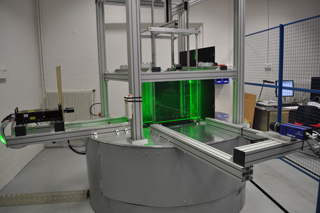
Gyroflow is a rotating platform designed for research in geophysical fluid dynamics.
This platform, 2 m in diameter, can rotate up to 1 ton of experiment and instruments, at a maximum angular velocity of 30 rpm.
The Gyroflow platform. Particle Image Velocimetry measurements are performed using the camera (right, in blue), and the pulsed laser (left, in black).
What is a geophysical flow?
Geophysical flows are flows dominated by the effects of rotation (through the Coriolis force) and stratification (through the buoyancy force due to a density gradient).
Large scale ocean currents and atmospheric circulations provide illustrations of the remarkable features of geophysical flows: quasi-two-dimensionality and the presence of large scale coherent vortices.
Geophysical flows are also present in gaseous planets - e.g., Jupiter's red spot -, in stars, or in the liquid cores of planets.
What is the effect of the Coriolis force on a flow
The Coriolis force deflects the trajectory of fluid particles, in a way similar to the effect of a magnetic field on charged particles. In an incompressible fluid, the resulting circular trajectory gives rise to an anisotropic propagative wave, called an inertial wave.
In the limit of large rotation rates, this inertial wave reduces to a column of fluid parallel to the rotation axis (Taylor-Proudman column), in which the flow is purely two-dimensional.
When the flow is turbulent, the effect of the Coriolis force is subtle: large scales may be dominated by the rotation, whereas small scales are not, because of their fast dynamics compared to the rotation rate. As a consequence, the large scales can be described as a system of superimposed inertial waves, leading to a partial two-dimensionalization of turbulence.
Rotating turbulence experiments
A series of experiments have been carried out to investigate the influence
of the Coriolis force on turbulence. Two experimental configurations have been
set up:
A decaying turbulence experiment, in which turbulence is generated
by the rapid translation of a grid in the fluid
A forced turbulence experiment, in which vortex dipole generators
continuously inject energy in the center of the flow.
Grid-generated decaying turbulence experiment on the rotating platform (october 2009).
Forced turbulence experiment, in which vortex dipole generators
continuously inject energy in the center of the flow (february 2013).
The forced turbulence experiments have been carried out in collaboration with P. Augier, P. Billant, J.-M. Chomaz and A. Garcia (Laboratoire LadHyX, Ecole Polytechnique).
The following papers are based on data obtained from the platform Gyroflow.
Wake of inertial waves of a horizontal cylinder in horizontal translation
N. Machicoane, V. Labarre, B. Voisin, F. Moisy, P.-P. Cortet, Phys. Rev. Fluids3 034801(2018)
[Abstract | PDF]
Two-dimensionalization of the flow driven by a slowly rotating impeller in a rapidly rotating fluid
N. Machicoane, F. Moisy and P.-P. Cortet, Phys. Rev. Fluids1, 073701 (2016)
[Abstract | PDF]
Turbulent drag in a rotating frame
A. Campagne, N. Machicoane, B. Gallet, P.-P. Cortet and F. Moisy, J. Fluid Mech.794, R5 (2016)
[Abstract | PDF]
Influence of the multipole order of the source on the decay of an inertial wave beam in a rotating fluid
N. Machicoane, P.-P. Cortet, B. Voisin, and F. Moisy, Phys. Fluids27, 066602 (2015)
[Abstract | PDF]
Disentangling inertial waves from eddy turbulence in a forced rotating
turbulence experiment
A. Campagne, B. Gallet, F. Moisy and P.-P. Cortet, Phys. Rev. E91, 043016 (2015)
Structure and dynamics of rotating turbulence: a
review of recent experimental and numerical
results
F.S. Godeferd and F. Moisy, Applied Mechanics Reviews67, 030802 (2015)
[Abstract | PDF]
Scale-dependent cyclone-anticyclone asymmetry in a forced rotating
turbulence experiment
B. Gallet, A. Campagne, P.-P. Cortet and F. Moisy, Phys. Fluids26 035108 (2014).
[Abstract | PDF]
Direct and inverse energy cascades in a forced rotating turbulence experiment
A. Campagne, B. Gallet, F. Moisy and P.-P. Cortet, Phys. Fluids26, 125112 (2014)
[Abstract | PDF]
Inertial waves and modes excited by the libration of a rotating cube
J. Boisson, C. Lamriben, L.R.M. Maas, P.-P. Cortet, F. Moisy, Phys. Fluids24, 076602 (2012).
[Abstract | PDF | movies]
Earth rotation prevents exact solid body rotation of fluids in the laboratory
J. Boisson, D. Cébron, F. Moisy, P.-P. Cortet, EPL98, 59002 (2012).
[Abstract | PDF]
Experimental evidence of a triadic resonance of plane inertial waves in a rotating fluid
G. Bordes, F. Moisy, T. Dauxois, P.-P. Cortet, Phys. Fluids24, 014105 (2012).
[Abstract | PDF]
Direct measurements of anisotropic energy transfers in a rotating
turbulence experiment
C. Lamriben, P.-P. Cortet, F. Moisy, Phys. Rev. Lett.107, 024503 (2011).
[Abstract | PDF]
Excitation of inertial modes in a closed grid turbulence experiment under rotation
C. Lamriben, P.-P. Cortet, F. Moisy, L. Maas, Phys. Fluids23, 015102 (2011).
[Abstract | PDF]
Viscous spreading of an inertial wave beam in a rotating fluid
P.-P. Cortet, C. Lamriben, F. Moisy, Phys. Fluids22, 086603 (2010).
[Abstract | PDF]